Blunt Code
Local-first code quality and security scanning for Windows.
Highlights
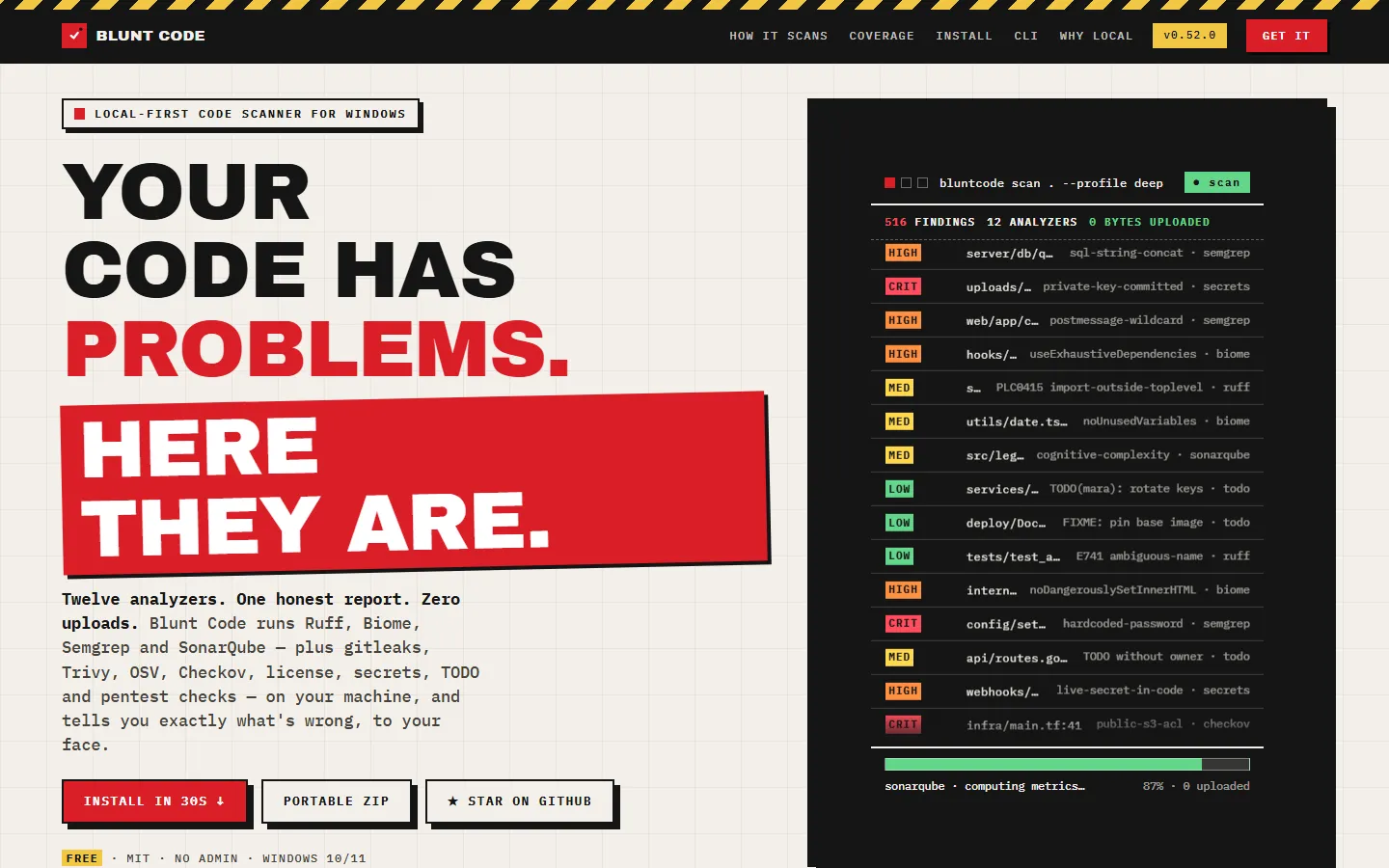
- Runs Ruff, Biome, Semgrep, and SonarQube in one workflow
- Includes secret scanning and TODO detection
- No cloud service, account, or telemetry
- MIT licensed; Windows release v0.52.0
What it does
Blunt Code combines several kinds of source inspection in one Windows application. It runs Ruff, Biome, Semgrep, and SonarQube, alongside secret scanning and TODO detection, then presents the results through a local web interface. The application is distributed as a Windows release and is currently at v0.52.0.
The point is not to replace those scanners. It is to make them available in one loopback app, so a developer can inspect a project without assembling a separate command-line workflow for each tool.
Why local-first matters to me
I often want feedback on code without sending that code to a hosted service. Keeping the scan local avoids a cloud account, telemetry, and a network dependency. It also makes the trust boundary easier to explain: the application runs on the machine where the code already lives.
That constraint shapes the product. The interface can feel like a modern web app, but the scan remains a local operation rather than a remote service.
How it is built
The application is written in Go with a web UI built using shadcn and Tailwind. Go orchestrates mature scanners instead of reimplementing their analysis rules. SQLite is part of the local application stack, and the whole system is packaged as a single Windows app with MIT-licensed source.
What I learned
The project reinforced how much of developer-tool quality sits outside the analyzer itself: invocation, local state, result presentation, packaging, and release distribution all matter. I also learned to prefer composing proven scanners carefully over writing shallow replacements for them.